

School Staff Room Food Storage
Maintaining rigorous food safety standards in school refrigerators is essential for protecting the health and well-being of the entire school community. Schools often serve as high-traffic environments where shared storage can lead to the accidental cross-contamination of expired or spoiled items with student provisions. Regularly checking for and discarding out-of-date food—such as the mouldy margarine mentioned in the recent incident—mitigates the risk of foodborne illnesses like salmonella or listeria, which can be particularly severe for children. Beyond physical health, consistent monitoring reinforces institutional accountability and prevents the logistical disruptions caused by avoidable medical emergencies and student absences.
Does Your School Have a Food Safety and Storage Policy?
A formal policy for staff refrigerators is more than just a matter of office etiquette; in a school setting, it is a critical component of safeguarding and operational health and safety.
It should include:
Rationale and Aim
A policy ensures the safe consumption of all foods brought onto school premises that are not related to Design Technology (DT) instruction, such as science experiments, international tasks, or class parties. The primary goal is to minimize the risk of food poisoning and allergic reactions by maintaining a hygienic environment and rigorous oversight.
Staffroom Fridge Conduct and Hygiene
Staffroom refrigerators are provided for the storage of personal, labelled food items. To maintain safety and order, the following rules apply:
Temperature Control: Fridges must be monitored with daily temperature checks to ensure they remain at or below 5∘C (41∘F);
Organisation: Items must be clearly labelled with the owner’s name and date of entry to prevent accidental disposal or "food theft," which can lead to workplace friction;
Hygiene & Spoilage: Fridges are cleaned regularly in accordance with school policy. Any expired, unlabelled, or leaking items will be immediately removed and discarded by cleaning staff; and
Separation of Risks: Raw meat and fish must always be stored on the bottom shelf to avoid dripping onto ready-to-eat foods.


Maintaining rigorous food safety standards in school refrigerators is essential for protecting the health and well-being of the entire school community. Schools often serve as high-traffic environments where shared storage can lead to the accidental cross-contamination of expired or spoiled items with student provisions. Regularly checking for and discarding out-of-date food mitigates the risk of foodborne illnesses like salmonella or listeria, which can be particularly severe for children. Beyond physical health, consistent monitoring reinforces institutional accountability and prevents the logistical disruptions caused by avoidable medical emergencies and student absences.
Always be Mindful of Your Fridge Leftovers
That container of leftovers might look fine, but appearances in the kitchen can be deceiving. In the UK, foodborne illnesses like Listeria and E. coli remain serious threats, often lurking in items we assume are safe just because they don’t "smell off" yet.
Understanding the science of the fridge is the best way to keep safe.
Decoding the Labels
One of the most common mistakes is confusing quality with safety.
Use-By Date (Safety): This is a hard deadline. After this date, food is no longer safe to eat, even if it looks perfect. High-risk items like smoked fish or deli meats can harbour Listeria, which can be particularly dangerous for vulnerable groups.
Best Before Date (Quality): This refers to texture and flavour. Food is generally safe to eat after this date, though it might not taste its best.
Prevent Cross-Contamination
Old food isn't just a risk to itself; it’s a risk to everything around it. Rotting produce or uncovered meats can spread mould spores and bacteria to fresh items. To maintain a sterile environment:
Seal It: Always use airtight containers to prevent juices or scents from migrating;
Check the Temperature: Ensure your fridge is set between 1°C and 5°C; and
Reheat Thoroughly: When eating leftovers, ensure they are steaming hot throughout (reaching at least 70°C.
The Golden Rule: When it comes to food safety, "if in doubt, throw it out." A missed meal is far better than a week of food poisoning.
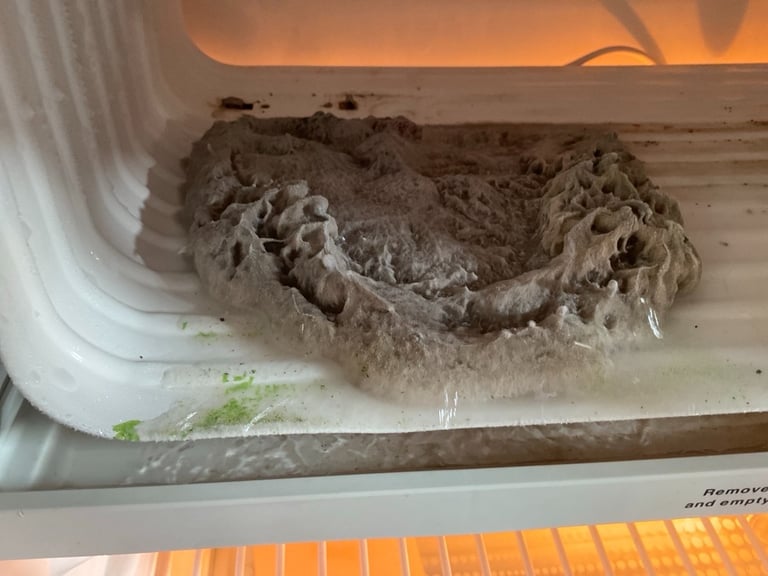
As part of a scheduled school visit, a Handsam Auditor found this in a Languages Department fridge:
Do You Know What's in Your Fridge?
Most of us are guilty of keeping leftovers for a week, but UK health guidelines are clear: consume leftovers within 48 hours. Bacteria thrive in the "danger zone"—temperatures between 8°C and 60°C. Even inside a chilled fridge, certain pathogens can multiply to unsafe levels over time. Because you cannot see, smell, or taste bacteria like Salmonella, relying on a "sniff test" is a dangerous gamble.
Office 27, East Moons Moat Business Centre
Oxleasow Rd, Redditch B98 0RE
Phone: 0333 207 0737